
Who are you?
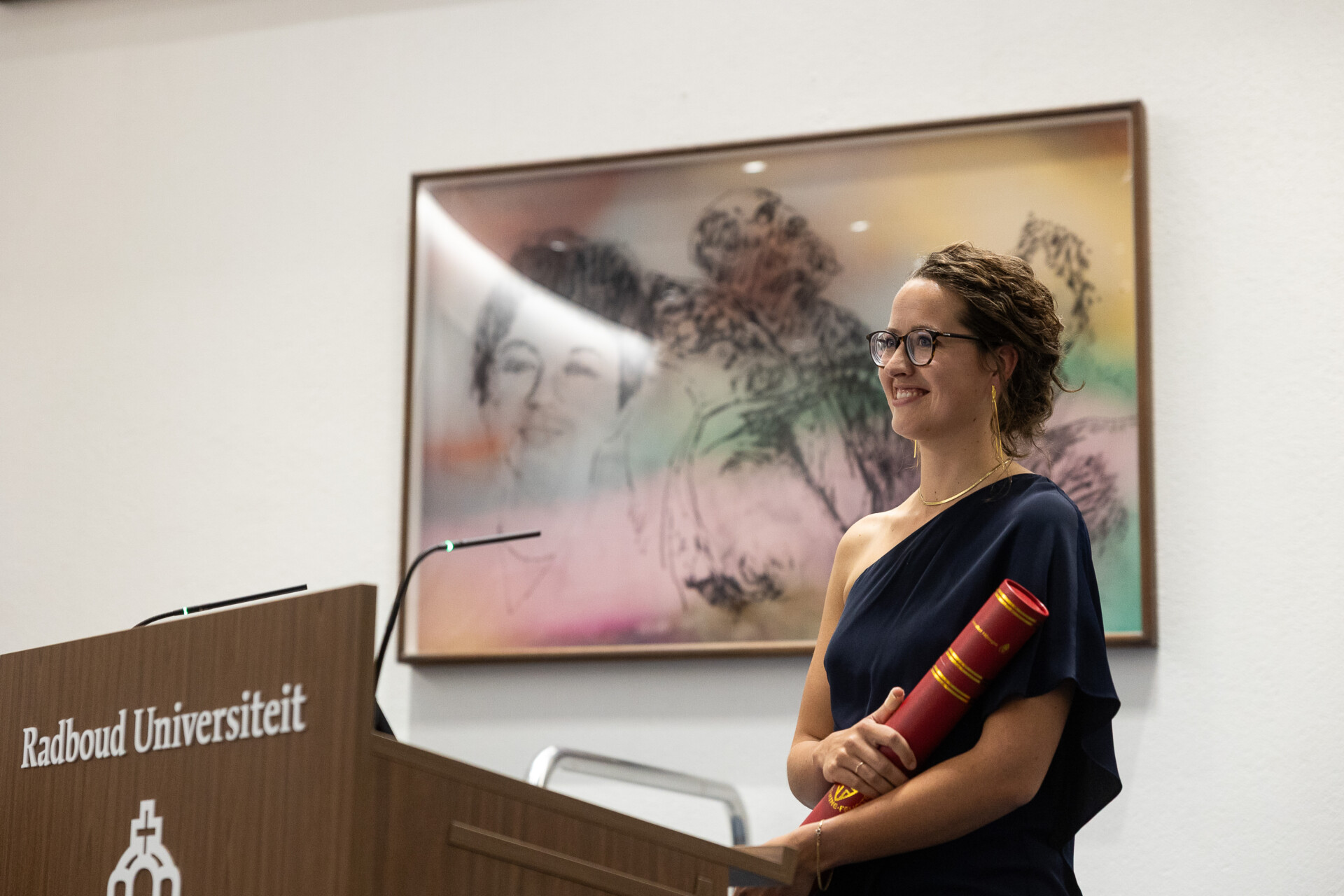
My name is Isa Mast. I am a human movement scientist, currently working as postdoctoral researcher at the Amsterdam UMC. As a movement scientist, it may come as no surprise that most of my hobbies involve exercise. In my free time I love to run, bike, CrossFit, sail, surf, hike, and play soccer (and that is not all). I love it even more when I can combine my hobbies with exploring a beautiful travel destination.
How did your PhD thesis come about?
My PhD research was funded by a Hypatia fellowship grant from the Radboud UMC awarded to my promotor Dr. Laurien Buffart. Among other goals, the grant aimed to explore the mechanisms and effects of exercise on clinical outcomes in patients with cancer. As I am fascinated by how exercise can benefit patients in the hospital beyond improving fitness, this was a topic I was particularly interested in. I was fortunate that Laurien invited me to join her team, giving me the opportunity to contribute to this important research topic.
Where do you work?
During my PhD I worked in the Exercise Oncology research group led by Dr. Laurien Buffart at the department of Medical BioSciences of the Radboud UMC. The focus of this research group is to unravel which exercise program is most effective to improve quality of life and treatment outcome, for which patients, and to understand the underlying mechanism.
Can you tell us something about your team?
My supervision team consisted of Dr. Laurien Buffart (epidemiologist and human movement scientist), Prof. Dr. Hans de Wilt (surgical oncologist), Prof. Dr. Maria Hopman (exercise physiologist), and Dr. Elske Gootjes (medical oncologist). This multidisciplinary team supported me with a valuable and diverse combination of perspectives, which was essential for the completion of my thesis.
Although doing a PhD is mostly an individual task, the Exercise Oncology research group was very supportive. The team included our group leader Laurien, two postdocs, and four to six other PhD candidates. Dealing with the challenging logistics of our clinical Exercise Oncology trials, we could always count on each other for help or support. I valued and enjoyed working as part of such a dedicated and diverse group of people, all aiming to contribute to the same goal.
What did you research?
Strong evidence exists on how physical activity during cancer treatment can improve physical fitness, reduce fatigue, and enhance quality of life1. However, evidence on the effects of exercise on clinical outcomes is limited, and the underlying mechanisms are mostly unknown. My PhD focused on two main topics. First, I investigated the effects of exercise during and after neoadjuvant cancer treatment on clinical outcomes, such as tumor regression and postoperative complications. Second, I explored the potential mechanisms through which exercise may reduce cancer-related fatigue in cancer survivors.
Can you tell us something about the design of our cover?
The cover design was inspired by my favourite place to be: the beach. I love long beach walks, the wind in my hair, and watching a beautiful sunset. Because my research focused on physical activity, I wanted my cover to reflect this with the bike symbolizing movement and exercise. I also wanted to symbolize hope, since the prospects for patients with cancer can be challenging. I hoped the cover would show that no matter how high the waves are or how endless the road may seem, life can still be beautiful with rays of sunshine breaking through. The painting was created by a former colleague and research technician from our department, Bregina Kersten. It now hangs above my desk and I still love it every day.
What are your main findings?
The main findings of the first part of my thesis were that exercise during and after neoadjuvant treatment is feasible for patients with rectal and oesophageal cancer and may have beneficial effects on physical fitness and clinical outcomes, such as treatment-related toxicity, tumor response and postoperative complications. In the second part of my thesis we demonstrated mechanisms via which exercise may reduce fatigue. Specifically, we showed that increases in muscle strength, physical activity, and sleep quality and decreases in muscle relaxation times and psychological distress were associated with reductions in fatigue severity in cancer survivors.
Can you give us 3 tips for clinical practice based on your research?
1. Currently, not all treating physicians are aware of the potential benefits of exercise during or after cancer treatment. Raising awareness about this is very important. My tip to medical oncologists, radiation oncologists, and surgeons is to advise their patients to stay active and, when appropriate, refer them to a physical therapist during their treatment.
2. I believe that exercising in the period prior to surgery can be beneficial not only physically, but also psychosocially. I am a fan of the way the Radboud UMC has implemented multimodal prehabilitation as standard care for patients undergoing major surgery. Even though we need more evidence on the effects of prehabilitation on clinical outcomes and further insight into who benefits most from a prehabilitation program and why, I think clinicians and hospitals should recognize and utilize the potential of these programs.
3. Lastly, we demonstrated the effects and underlying mechanisms of a walking program on cancer-related fatigue. Walking is a low-burden form of exercise. Another tip for clinicians would be that if patients do not want to follow a structured exercise program or go to the gym, simply informing them about the benefits of (brisk) walking can help to lower the perceived barriers to become or stay physically active.
What are 3 challenges that need further investigation?
1. Our studies are among the first to show the effects of exercise on tumor response during the neoadjuvant period in patients with rectal and oesophageal cancer. Recently, the large CHALLENGE trial showed that a structured exercise program after treatment can improve disease-free survival in patients with colon cancer2.
Together, these findings contribute to growing evidence that exercise has potential to improve clinical outcomes and could serve as an adjunct therapy for patients with cancer. However, the underlying physiological mechanisms remain unknown. A key challenge is to elucidate these mechanisms to optimize exercise prescriptions and maximize the potential of exercise as therapy.
2. An important future challenge is to determine who benefits most from prehabilitation and why. We demonstrated that multimodal prehabilitation can be beneficial for patients with esophageal cancer, but I am intrigued by the underlying mechanisms. Understanding these mechanisms would help us personalize prehabilitation programs to maximize the benefit.
3. For cancer survivors, exercise might provide an effective alternative treatment strategy to pharmaceutical approaches in the reduction of fatigue. A future challenge is to elucidate the causal mechanisms by which exercise affects fatigue and explore the potential additional benefits of incorporating psychosocial support, as well as developing targeted exercise prescriptions for cancer survivors in line with the FITT principles.
References
1. Campbell, K. L., Winters-Stone, K. M., Wiskemann, J., May, A. M., Schwartz, A. L., Courneya, K. S., . . . Schmitz, K. H. (2019). Exercise Guidelines for Cancer Survivors: Consensus Statement from International Multidisciplinary Roundtable. Med Sci Sports Exerc, 51(11), 2375–2390. doi:10.1249/mss.0000000000002116
2. Courneya, K. S., Vardy, J. L., O’Callaghan, C. J., Gill, S., Friedenreich, C. M., Wong, R. K. S., . . . Booth, C. M. (2025). Structured Exercise after Adjuvant Chemotherapy for Colon Cancer. New England Journal of Medicine, 393(1), 13–25. doi:10.1056/NEJMoa2502760
Lees het artikel als pdf: