
Who are you?
‘My name is Judith-Elisa Kaufmann. I am a dance scientist, international (university) lecturer for dance medicine, science and pedagogy and former professional dancer (ballet, flamenco), pedagogue, and choreographer.’
How did your PhD thesis come about?
‘My dance career was terminated way too early due to injuries and ill-health. After that I became a highly motivated pioneer of dance medicine in my country Austria and beyond. It has become my mission to change tradition-steeped approaches to dancers’ education and training. My goal is to make dance pedagogy a science which builds upon dance science and dance medicine. Many scientific aspects needed to achieve this have not been researched yet. Despite the need and lack of research no university I applied to was interested. When I met professor Pancras Hoogendorn, he immediately acknowledged the importance and supported me with a dream team: Maaike Gademan and Rob Nelissen. They welcomed me at LUMC and together we have worked to advance dance medicine, science and pedagogy.’
Where do you work?
‘I am the principal of the Academy for Dance Pedagogy & Dance Medicine in Austria. I work internationally as a (university) lecturer, author, researcher, and specialist for dance science, dance medicine and dance pedagogy.’
Can you tell us something about your team?
‘My supervisors were professor Dr. Rob G.H.H. Nelissen (orthopaedics) and associate professor Dr. Maaike G.J. Gademan (Human Movement Scientist and Clinical Epidemiologist). Dr. Elisabeth Exner-Grave, back then head of the dance rehabilitation clinic Medicos. AufSchalke, Dr. Paul R. Appleton, a Sports and Exercise (Psychology) Scientist from Manchester Metropolitan University, and Dr. Janine H. Stubbe and Dr. Rogier M. van Rijn, professors for Performing Arts Medicine at Codarts, supported the team with their expertise.’
What did you research?
‘My thesis ‘Dance Medicine – Risk Factors for Dancers’ Musculoskeletal Injuries’ focused on investigating risk factors for musculoskeletal injuries in professional dancers. Most risk factors have not yet been investigated or are still under-researched. If we want to introduce necessary changes to reduce the very high numbers of dancers’ injuries and health problems we need this information. We examined the association between the dance technique of ‘turnout’ and injuries1.
‘Turnout’, as the most fundamental aspect of ballet technique, refers to the maximal external rotation of the hip and the necessary contributions of the lumbar spine, knee, and foot in a dancer. The aim is to increase range of motion, equilibrium, and three-dimensional aesthetics in dance technique (Figure 1).
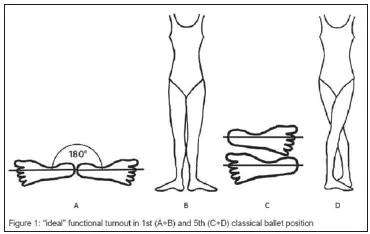
FIGURE 1 Classical ballet positions.
Several studies had investigated the association between injuries and the traditional striving for ‘ideal’ turnout of 180°. I found that older studies were based on a misconception of ‘forced’ and ‘compensated’ turnout. I proposed a medical definition of these two dance technical concepts and suggested new biomechanical approaches for future research based upon them.
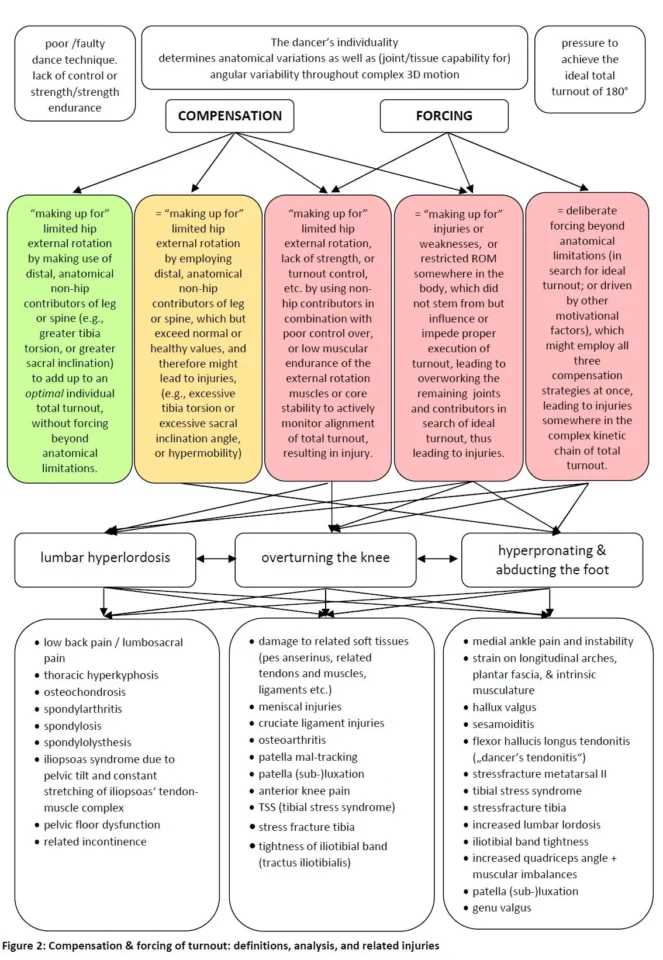
FIGURE 2 TURNOUT Medical Definition Compensation & Forcing. Kaufmann 2019.
I also investigated three new aspects of injury prevention. Firstly, the association between teacher-created motivational climate and musculoskeletal injuries in ballet dancers2. We found that disempowering behavior of teachers and ballet masters is linked to acute as well as overuse injuries. This shows, how necessary it is to change from traditionally authoritative, controlling behavior of teachers3,4 towards new evidence-based approaches in dance training.
Secondly, we looked at the role of warming-up in ballet, documented warming-up habits, as well as the association between neuromuscular warm-up and musculoskeletal injuries5. In sports science, the role of warm-up for performance enhancement and injury prevention has been studied extensively. In dance, however, no study had investigated warm-up before.
In traditional dance practice, stretching as well as dance technical drills are misinterpreted as warm-up. We found those approaches to be associated with higher numbers of injuries, while neuromuscular routines performed by ballet dancers were linked to an average of 2.5 overuse injuries less per dancer. The latter was specifically interesting, because the vast
majority of ballet injuries are overuse injuries2,6. Neuromuscular warmingup might help prevent these injuries. Thirdly, we asked dancers how much support for their injury prevention they received from their teaching personnel. We also asked which causes they perceived for their acute and overuse injuries7. We found that the teacher, master or choreographer plays a key role in injury prevention through proactive implementation of dance medicine/science into practice. Moreover, dancers identified fatigue as the most important risk factor for acute injuries. The behavior of teaching personnel was regarded as the leading perceived cause for overuse injury, followed by errors in dance technique and previous injuries. Finally, we assessed the stress dancers perceived during and after injuries in order to determine, whether injury can be regarded as a stressor for dancers8. Traditionally, young dancers are taught to dance through and work with injuries. They are supposed to consider injuries as part of their profession and misinterpreted sign of their dedication. Our results show that injuries are stressors in themselves. The increasing stress levels for repetitive injuries we found could be manifestations of the misconceptions in dance culture with resulting stress, if dancers have to dance in pain, constantly in fear of re-injury.’
Can you tell us something about the design of your cover?
‘The cover (Figure 3) symbolizes the importance of regarding a dancer as a living individual on the one hand, and the necessity of a holistic approach to their training and
health on the other. Everything is interrelated; physique, psyche and mental health. The picture, which was me in a solo role, stands for the moving, living individual, while the interlacing waves suggest fascia, attempting to symbolize holistic complexity in constant motion, hence potential for development and progress.’
FIGURE 3 The cover of Judith-Elisa Kaufmann’s dissertation.
What are your main findings?
• Research on turnout needs uniform definitions for the underlying variables to provide reliable data on the association with injuries. New approaches should focus on dancers’ individual capabilities first and move away from goals informed by aesthetics without biomechanical benefit.
• Teacher-created disempowering motivational climates are associated with more musculoskeletal injuries in dancers. Teachers/ballet masters/choreographers play a key role for injury prevention, health and wellbeing. Their required proactive implementation of knowledge in dance medicine and science needs mandatory evidenced-based pedagogical education.
• Neuromuscular warming-up has potential for injury prevention in dance.
• Evidence-based injury prevention approaches need to replace outdated traditions. We need to change the culture from working with and glorifying pain and injury. As injuries are stressors, preventing them, but also reporting and rehabilitating them is crucial.
Can you give 3 tips for clinical practice based on your research?
1. Dancers have unique injuries, risks, and needs due to specific biomechanical demands. Being familiar with dancers’ worlds, work, and techniques is essential for successful diagnosis, treatment, rehabilitation, and return-to-dance training.
2. Clinical rehabilitation for dancers needs focus on coping skills and the correction of training deficits, such as education towards evidence-based forms of warming-up.
3. Most injuries are overuse in nature. Treatment should be multidisciplinary involving dance medical specialists. Dance technique and training need to be assessed for errors to prevent re-injury. This should be a proactive and empowering cooperation with the dancer and their institution to protect the dancer.
What are 3 challenges that need further investigation?
1. The complex interactions between injury, pain sensitivity9, mental health and stress in the unique setting of dance should be further investigated.
2. The facilitators and barriers to implementing better injury prevention and treatment strategies in the dance environment should be explored in more depth.
3. Investigating turnout, its biomechanics as well as association with injuries, is challenging due to its complexity. Standing-turnout (Figure 1) has been researched, but dancers hardly stand, they move. Turnout thus is a whole-body motion, not a position. Future research, albeit challenging, should investigate the dynamic nature of turnout and its biomechanics with their constantly changing and interacting threedimensional articular contributions.
References
1. Kaufmann JE, Nelissen R, Exner-Grave E, Gademan MGJ. Does forced or compensated turnout lead to musculoskeletal injuries in dancers? A systematic review on the complexity of causes. J Biomech. Jan 4 2021;114:110084. doi:10.1016/j.jbiomech.2020.110084
2. Kaufmann JE, Nelissen RGHH, Appleton PR, Gademan MGJ. Perceptions of Motivational Climate and Association with Musculoskeletal Injuries in Ballet Dancers. Medical Problems of Performing Artists. 2021;36(3):187-198. doi:10.21091/mppa.2021.3021
3. Lee SA. The artist as teacher: A psychological perspective. Medical Problems of Performing Artists. Jun 1997;12(2):38-41.
4. Lakes R. The Message behind the Methods: The authoritarian pedagogical legacy in Western concert dance technique, training and rehearsals. Arts Education Policy Review. 2005;106(5):3-18.
5. Kaufmann JE, Nelissen RGHH, Stubbe JH, Gademan MGJ.
Neuromuscular Warm˗Up is Associated with Fewer Overuse Injuries in Ballet Dancers Compared to Traditional Ballet˗Specific Warm˗Up. J Dance Med & Sci. 2022;26(4):244-254.
6. Allen N, Nevill A, Brooks J, Koutedakis Y, Wyon M. Ballet injuries: injury incidence and severity over 1 year. J Orthop Sports Phys Ther. Sep
2012;42(9):781-90.
7. Kaufmann JE, Nelissen RGHH, Stubbe JH, Gademan MGJ. The perspective of ballet dancers on causes of their injuries and implementation of injury preventive measures by their ballet teachers and masters. Medical Problems of Performing Artists. 2024;39(2):93–107.
8. Kaufmann JE, Stubbe JH, Nelissen RGHH, van Rijn R, Gademan MGJ. Injury as a stressor in 67 first year contemporary dance students: A longitudinal cohort study. in submission. 2025;
9. Tajet-Foxell B, Rose FD. Pain and pain tolerance in professional ballet dancers. Br J Sports Med. Mar 1995;29(1):31-4. doi:0.1136/bjsm.29.1.31
Go to the dissertation of Judith-Elisa Kaufmann
Bekijk het artikel als pdf: